A request that sounds simple
This scenario is hypothetical.
An IT support agent starts as a reader. It reads tickets, searches past incidents and suggests fixes to the engineer on shift. Nothing changes until a person acts.
Later it gains tools to restart services, change user access and close incidents. Each connection was approved separately and looked small.
Then a user writes: “The payroll portal is down. Please restore service.”
The agent proposes a plan. Restart the portal’s application service. Restart the database proxy the portal connects through. Give the user temporary administrator rights so they can confirm the fix. Close the incident.
None of these steps is automatically safe. Even the application restart should run only if an approved runbook covers it and conditions allow it: the right environment, no change freeze, no maintenance on a dependency. The proxy is a larger step. Here it is shared: payroll, expenses and the HR portal all reach their databases through it, so a restart drops connections for all three. The access change affects someone who never asked for it. Closing the incident ends a record another team may still need.
“Restore service” was a reasonable request, not permission for all four actions. The agent had access to every tool in its plan. Nobody had decided whether it had authority to use them here, now.
Several separate decisions hide inside that gap. Identity is which agent is acting: this support agent, not a person or a generic service account. Authentication is how that identity is verified. Validating the token establishes the calling identity represented by that credential. The tool must also evaluate whether the requested action on the resource is permitted. That is authorisation: may this identity restart the shared proxy, or only the portal’s own service? Business approval asks whether this particular action, now, has been agreed. Accountability is who owns the outcome and the recovery when the expense system loses its connections. A deployment can handle identity, authentication and authorisation while still leaving business approval and accountability unclear.
Why this matters now
On 27 October 2026, IBM announced identity and control capabilities for AI agents, including a record of who owns each agent, short-lived credentials issued through HashiCorp Vault, and a containment capability, Orchestrate Contain, that is in technical preview. On 15 October, ServiceNow announced AI Passport, a signed credential describing what an agent is authorised to do, checked while the agent runs. ServiceNow says it expects availability in Q4 2026.
These are vendor announcements, not independently tested results. The useful signal is the shared pattern: the authority check sits outside the model.
That matters because a prompt is not a permission boundary. An instruction such as “never restart shared components without approval” guides the model; it does not stop the call. A model can misread it, or follow text planted in a ticket it was asked to summarise. OWASP’s guidance on prompt injection describes this indirect form and recommends enforcing privileges outside the model. The control that counts is the gateway, tool or system that refuses the call whatever the model concluded.
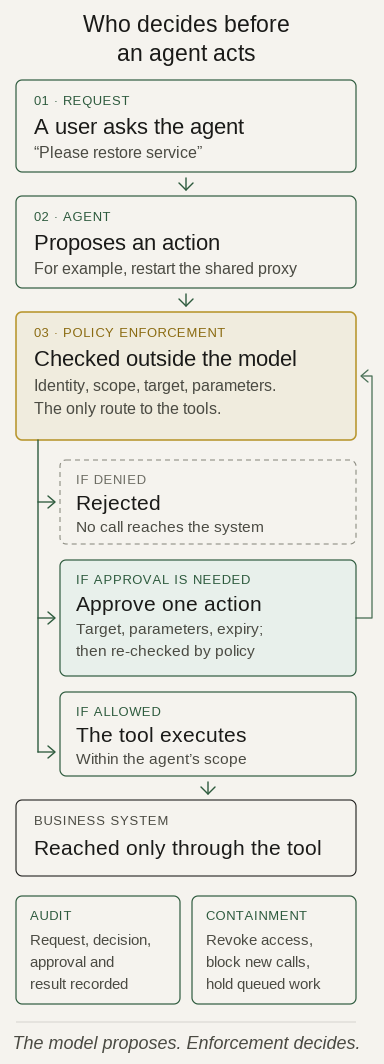
Six checks before an agent acts
1. Identity
Failure mode. The agent runs under a shared service account, or under the credentials of the engineer who built it. When the proxy restarts, the log says a person did it.
Control. Give the agent its own identity with a named owner. Keep it distinct from the user it acts for, so every action records which agent acted and on whose request. Do not let the agent reuse human credentials.
Evidence. The agent’s directory entry and owner, and an audit event showing agent and requesting user as separate fields.
2. Scope
Failure mode. The restart tool accepts any service name in any environment, because it was built for a human operator trusted to choose well.
Control. Limit the tools, actions, resources and environments the agent can reach. Reading a ticket and restarting a production service are different permissions. Where possible, scope by named resource: restarting the portal’s service is one permission; restarting any service is another.
Evidence. The access policy itself, plus a test showing an out-of-scope request is refused.
3. Approval
Failure mode. An engineer approves “restart the portal service.” The agent then restarts the shared proxy under the same approval.
Control. Decide in advance which actions need approval, and bind each approval to a specific action, target and parameters, with an expiry. If the target changes or the scope grows, a fresh approval is needed.
Approval does not execute anything by itself. The approved action returns to the same enforcement check, which confirms that action, target, parameters and expiry still match and that the agent’s permissions have not changed since. This works only if enforcement is the sole route: no alternative credential or direct tool connection can skip it.
Keep this proportionate. Routine reads within an approved scope can proceed automatically. Sensitive records, bulk extraction and cross-boundary access may need additional controls. Changes to shared systems, access rights and anything hard to reverse should wait for approval.
Evidence. An approval record naming action, target, parameters, approver and expiry; a test showing an approval for one target cannot be used for another; and a test showing a call that bypasses enforcement fails.
4. Delegation
Failure mode. The support agent hands the restart to an infrastructure agent with broader permissions. The work now runs with authority the original request never had.
Control. Downstream execution must stay within the explicitly delegated task and within the receiving agent’s own permissions. The infrastructure agent’s broad role does not authorise anything the delegation did not ask for, and the delegation cannot grant what that agent lacks. Any additional authority needs a separate, explicit authorisation decision. Pass the original request and requesting identity along the chain.
Evidence. A delegation trace showing the originating request, each agent involved, the task delegated and the permissions applied at each step.
5. Evidence
Failure mode. Something goes wrong and the only record is a chat transcript.
Control. Record the request, the acting identity, the policy decision, any approval, the tool call and its result. This operational audit evidence does not require storing the model’s private reasoning; an auditor needs what was requested, allowed and done. Treat logs as sensitive: ticket text, user details and command output may need masking.
Evidence. A sample audit event for one completed action, and the access policy for the log store.
6. Containment and recovery
Failure mode. Someone disables the misbehaving agent. Two queued restarts still run, and the access change it made an hour ago stays in place.
Control. Revoking credentials is necessary but not always immediate. Issued tokens may stay valid until they expire or a system checks revocation, and a target may finish work it already accepted. So block at the execution points too: refuse new calls at the gateway and tools, cancel or hold queued work, and identify in-flight actions. A kill switch stops new activity; it does not guarantee cancellation of running work, and reverses nothing. Recovering completed actions is a separate plan. Some actions cannot be fully reversed; others depend on backups or compensating actions.
Evidence. A non-production containment test showing time until new calls were refused, the fate of cached tokens, queued and in-flight work, and a list of irreversible actions.
An architecture-review table
| Check | Question to ask | Evidence to request |
|---|---|---|
| Identity | Which agent is acting, who owns it, and on whose behalf? | Directory entry with owner; audit event recording agent and user separately |
| Scope | Which tools, actions, resources and environments can it reach? | Access-policy example; test showing an out-of-scope call refused |
| Approval | What does an approval cover, and is it re-checked before execution? | Approval record bound to action, target, parameters and expiry; bypass test |
| Delegation | Can a handoff to another agent widen what is allowed? | Delegation trace from original request to final action |
| Evidence | Can we reconstruct what was requested, allowed and done? | Sample audit event; log-access and masking policy |
| Containment and recovery | How do we stop new and queued work, and what can we not undo? | Non-production containment test; list of irreversible actions |
A practical next step
Choose one connected agent. List every tool it can reach and every action those tools allow. Find the highest-impact action: the one that touches shared systems, changes access or cannot be reversed.
Test that action somewhere safe: a sandbox, a dry-run mode, or a controlled test environment running the same policies as production. Try it without approval, with an approval issued for a different target, and through a route that avoids the enforcement point. Then run containment and record how long until new calls are refused, and what happens to queued and in-flight work. Never attempt unapproved high-impact actions in live production.
Define and test the limits of an agent’s authority before you expand its access.