Most architecture documentation I have encountered over twenty years describes systems rather than decisions. It tells you what exists, how components connect, what protocols are in use. What it rarely tells you is why — why this component rather than another, why this pattern rather than the alternatives, what problem the current structure was designed to solve and whether that problem still exists.
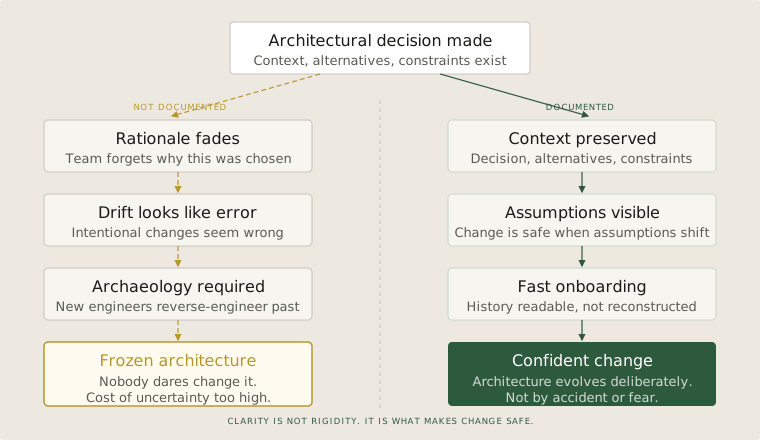
Without the why, architecture documentation is archaeology. Engineers inherit it, try to infer the intent from the structure, and either guess correctly or make changes that quietly break assumptions nobody wrote down. This is where technical debt is actually born — not in bad code, but in decisions whose rationale has been lost.
Decisions, not diagrams
A useful architectural record captures the decision, the context in which it was made, the alternatives that were considered, and the constraints that made those alternatives less suitable. It does not need to be long. A paragraph is often enough. But it needs to be honest — including about the weaknesses of the chosen approach and the conditions under which it should be reconsidered.
This format — sometimes called an Architecture Decision Record — is not new. What is less common is the discipline of maintaining it. Teams write them enthusiastically at the start of a programme and then stop as delivery pressure increases. The early decisions are documented; the later ones — often the more consequential ones made under time pressure — are not.
The result is a system whose recent history is opaque. New engineers can understand the original intent but cannot understand why the current state diverges from it. The divergence looks like drift; often it was deliberate adaptation whose rationale was never captured.
What clarity enables
Architectural clarity does not mean architectural rigidity. A clear decision record makes it easier to change decisions when the context changes — because the team can see exactly what was assumed when the original decision was made, and whether those assumptions still hold.
Without clarity, change is difficult not because the technology is hard to change, but because nobody is confident about what else might break. The unknown dependencies. The undocumented assumptions. The integrations that were built around a specific behaviour that was never documented as a contract. Clarity reduces this uncertainty — not to zero, but to a manageable level that teams can reason about.
Clarity also reduces the cost of onboarding. An engineer who joins a team with good architectural documentation can become productive meaningfully faster than one who has to discover the system's decisions by reading its implementation. That difference compounds across every person who joins and every quarter that passes.
The discipline of being explicit
Architectural clarity is not a documentation project. It is a communication discipline. It means that when a significant decision is made — about platform, about integration pattern, about data ownership, about security boundary — someone writes down the decision, the reasoning, and what it depends on, before the meeting ends.
This is harder than it sounds under delivery pressure. It requires the team to resist the pull toward the next decision and spend ten minutes on the one just made — before the rationale dissolves. 'We will document it later' almost always means it will not be documented. Leadership that understands this protects the time; most does not.
Teams that develop this discipline build systems that are easier to maintain, easier to extend, and easier to hand over. The investment is small. The return is consistent and long-lasting.
Why clarity compounds
Architecture is decision clarity. Not the clarity of a perfect design made in advance — no design survives contact with reality unchanged. But the clarity of knowing what was decided, why it was decided, and what would need to be true for that decision to be revisited.
Systems that have this clarity can evolve. Systems that do not accumulate the kind of quiet uncertainty that eventually makes change too risky to attempt — and that is when architecture becomes a constraint rather than an enabler.
Before the next decision
- Document the why, not just the what. A decision without context is archaeology waiting to happen — someone will eventually have to infer the intent from the structure, and they will sometimes guess wrong.
- Write decision records at the moment of decision, not later. "Later" almost always means never, especially under delivery pressure.
- Clarity enables change. Teams that know why decisions were made can revise them confidently when context changes. Teams that do not know will avoid changing anything they cannot fully understand.
Decision Architecture
The Four Tests of an Architecture Decision
Test 01
Clarity
Has the actual decision been stated? Not the option being considered, not the direction being explored — the decision itself, in writing, with the alternatives named.
Test 02
Sequence
Is it being made at the right point in the programme? The same decision costs almost nothing early and can cost a programme when made late. Sequence is where most of the cost is hidden.
Test 03
Ownership
Is someone accountable for making and sustaining it? A decision without an owner drifts. Ownership means someone will notice when the context changes and the decision no longer holds.
Test 04
Consequence
What becomes harder, more expensive, or irreversible afterward? Every significant decision forecloses options. Naming those options before deciding is the discipline that separates architecture from guesswork.
Applied to this essay
- Is the architecture you are working with right now expressed as decisions, or as diagrams?
- Which decisions are load-bearing — and do the people building on them know that?
- When the context changes, how will you know which decisions need to be revisited?