People reach for the phrase "calm architecture" when they mean tidy diagrams. That is not what it is. Calm architecture is a property a system has when you can trace a request from entry to response without your eyes crossing.
The test is not visual. The test is: when an incident happens at two in the morning, can the on-call engineer follow the path the request took, find where it failed, and fix it without waking up two other teams?
In a calm system, yes. In a tangled one, no. Same features. Same business value on paper. Wildly different cost to operate.
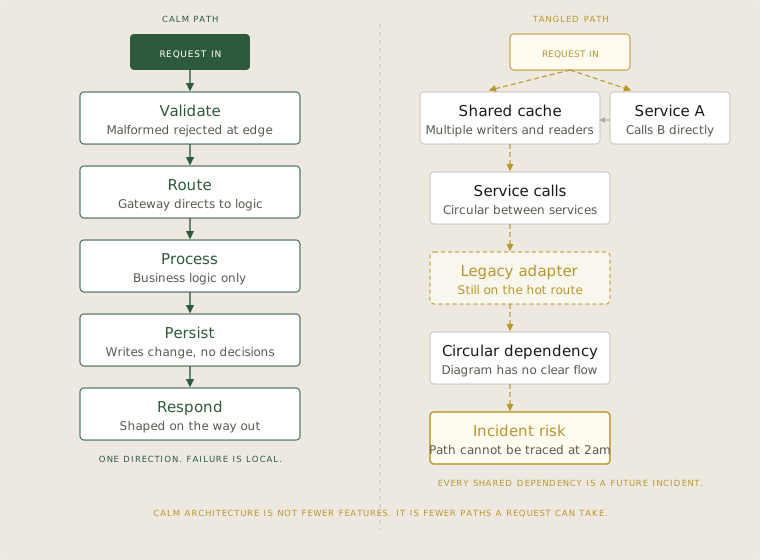
The calm path: one direction, one job per layer
A request enters at one place. It is validated at the edge — anything malformed is rejected before it ever reaches business logic. The business layer decides what should happen. The persistence layer writes the change. The response shapes itself on the way out.
Five layers. One direction. Each layer has one job, and only one. The validation layer does not also write to the database. The persistence layer does not also make business decisions. The boundaries hold because the team holds them.
When something fails, the failure is local. A validation bug shows up at the edge and never touches state. A persistence error shows up at one layer and you know exactly which one. Nothing surprises you. That is what people mean when they say a system is operable — not that it never fails, but that when it fails, you can find the failure.
The tangled path: every service knows every other
Now take the same request and route it through a system that grew without discipline. The gateway calls service A. Service A calls service B and also calls service C directly because someone needed it once. Service B reads from a shared cache that service C also writes to. The legacy adapter is somewhere in the middle of all of it because nobody had time to remove it.
The diagram for this is not a flow. It is a graph. Arrows go in every direction. Some of them are dashed because nobody is sure if that dependency is still real.
When an incident happens, the engineer cannot follow the path. The path forks. The path loops. The path includes a service that was supposed to be deprecated last quarter but turns out to still be on the hot route. The on-call engineer's first hour is spent reconstructing the architecture, not fixing the bug.
How the tangled one happens
Nobody designs a tangled system. They arrive at one. The mechanism is almost always the same: every shortcut taken under deadline pressure adds one more direct call. Every "we will refactor this later" adds one more shared dependency. Every "just for now" adds one more reverse arrow. Nobody ever goes back to remove these, because they all still work.
The tangled system is not the result of bad engineers. It is the result of good engineers under pressure, making locally rational decisions that are globally expensive. The cost lands later, on people who were not in the room when the decisions were made.
The discipline is not building features. It is refusing paths.
Calm architecture is maintained by saying no to specific shapes of change. No, service C cannot call service A directly — it must go through the gateway. No, the legacy adapter is not allowed a new caller — if you want that data, get it from the API. No, you cannot share that cache between two services — give each its own.
These refusals look like obstruction in the moment. They are not. The traceability a year from now depends almost entirely on the calls that were made here. The architects who make those calls and hold the line are doing the actual work of architecture, even when it does not feel like building anything.
What calm costs to maintain
Calm architecture is not fewer features. It is fewer paths a request can take. Every extra branch, every shared mutable thing, is a future incident looking for a bad day to arrive.
The choice to keep it calm is made one decision at a time, and most of those decisions are refusals.
Signals to look for
- If you cannot trace a request from entry to response in one direction, the architecture is not calm — regardless of how clean the diagrams look.
- Tangled systems are built by good engineers under pressure, not bad engineers. The discipline lives at the design review, not in the code.
- Most of the work of keeping a system calm is saying no to specific shapes of change. The "no" is the architecture.