That difference matters, and most enterprises have not yet reckoned with it.
The current wave of enterprise AI investment is concentrated on models, infrastructure and tooling. Organisations are choosing platforms, comparing copilots, building agent frameworks. Far less attention goes to a quieter question: is the information these systems will draw on actually organised well enough to be trusted?
This is not a new problem. It is an old problem that AI has made urgent.
AI can retrieve information — but can it understand it?
Search and retrieval technology has improved enormously. Modern AI systems can index a vast range of content — documents, wikis, tickets, emails, recordings — and surface something relevant to almost any question within seconds. Retrieval is no longer the hard part.
Understanding is the hard part.
Finding a document is not the same as knowing whether it is the current version, whether it has been superseded, whether it applies in this context, or whether the person — or system — reading it is even entitled to. A search engine returns matches. It does not, on its own, return authority, currency or applicability. Those are architectural properties, and they have to be designed in; they do not emerge from a bigger index.
More documents do not create better knowledge
Consider a fictional example. A global organisation has grown over two decades through a mix of organic expansion and acquisition. Its policies, technical standards, project records and operating procedures are scattered across collaboration platforms, shared drives, wikis and line-of-business applications. Nobody planned it this way; it simply accumulated.
Several versions of the same policy exist, drafted at different times by different teams, with no clear record of which one is current. Ownership has drifted — the person who approved a standard five years ago has moved on, and nobody formally inherited the decision. Access permissions have been granted, copied and re-granted so many times that almost nobody could explain, with confidence, who can see what and why.
An AI agent pointed at this environment will find plenty of relevant-looking material. What it cannot reliably determine is which version is authoritative, whether the content is still valid, who owns the underlying decision, whether it applies to this country or business unit, and whether the agent is merely permitted to read the material or to act on it. A bigger search index does not resolve any of that. It just makes the ambiguity easier to retrieve.
Five information failures that weaken enterprise AI
A handful of recurring problems sit underneath most of these situations.
The first is multiple versions of the truth — the same policy or standard existing in slightly different forms across different systems, with no single place a reader, human or machine, can trust as final.
The second is missing or unclear information ownership. When nobody is accountable for a piece of information, nobody updates it, corrects it or retires it when it is wrong. Ownership is what keeps information alive; without it, content simply ages in place.
The third is inconsistent terminology and business meaning. The same word can mean different things in different parts of a large organisation — "region," "active," "approved," "owner" — and an AI system that treats these terms as interchangeable will quietly produce answers that are technically correct and practically wrong.
The fourth is weak metadata, classification and lifecycle management. Without a reliable way to tag information by sensitivity, applicability, validity period and status, a system has no basis for deciding what is safe to surface or when something has expired.
The fifth is unclear access rights and decision boundaries. Permissions that have accumulated informally over years rarely reflect what should be true today. An AI system inherits whatever access it is given — it does not question it, and it will not know if that access has quietly become too broad.
None of these five problems is new. They predate AI by decades. What has changed is the cost of leaving them unresolved.
From inaccurate answers to incorrect actions
The consequences of weak information architecture scale with what the AI is permitted to do. As autonomy increases, the tolerance for ambiguous or unowned information should fall, not stay constant.
| Autonomy level | What it does | What goes wrong if the information is unreliable |
|---|---|---|
| Read | Retrieves and summarises information | A wrong answer — usually caught and corrected by a person |
| Recommend | Suggests a course of action | Shapes a decision even when a human formally approves it |
| Decide | Chooses within a defined set of rules | Removes a layer of human judgement from the loop |
| Execute | Changes a record, triggers a process, moves money, grants access | Closes the loop — the consequence has already happened |
Governance has to scale with consequence. An organisation that would never let an ill-defined policy sit unresolved for years should not be comfortable letting an autonomous agent act on that same policy simply because the agent is fast and confident.
What AI-ready information architecture looks like
Getting this right does not mean moving every document into a single system, and it does not mean a one-off clean-up exercise. It means building a small set of durable capabilities.
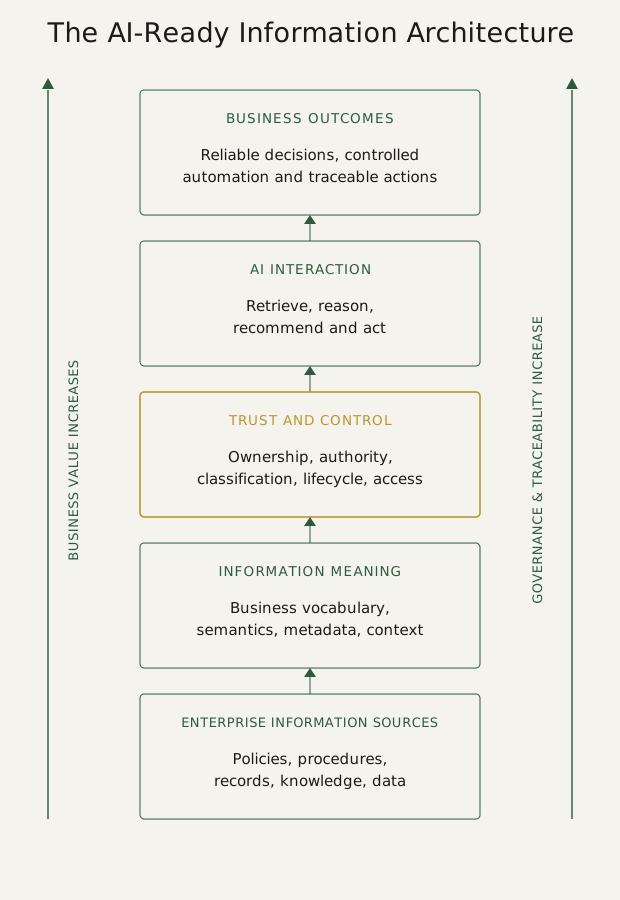
Authoritative sources need to be identified and declared, so there is a single place an AI system — and a person — should trust for a given type of information. Named owners, for both business and information, need to exist so that accountability for accuracy sits somewhere real. A shared business vocabulary needs to define what key terms actually mean across the organisation, closing the gap that lets the same word mean different things in different places.
Metadata and classification standards need to make sensitivity, applicability and status explicit rather than implicit. Version and lifecycle controls need to retire information on a schedule rather than leaving it to decay indefinitely. Access needs to be role-based and purpose-based, reflecting what should be true now rather than what has accumulated over time.
Every AI response or action needs to be traceable back to its source, so a decision can be audited rather than taken on faith. And all of this needs continuous review — information architecture is an operating discipline, not a project with an end date.
A practical readiness test for enterprise architects
Before extending an AI system's reach into a given domain of information, a short set of questions is worth asking honestly.
What is the authoritative source for this information? Who owns and approves it? How is its business meaning defined? Where does it apply, and where does it not? When was it last reviewed? Who may access it? What is the AI system actually permitted to do with it — read, recommend, decide or act? Can every significant recommendation or action be traced back to its source? What happens when the information is uncertain or conflicting? And is there a genuine human escalation and override path, or only a theoretical one?
If several of these questions cannot be answered with confidence, that is useful information in itself. It says more about readiness than any benchmark of model capability.
The architect's role
Enterprise architects are well placed to hold this problem, not because they should own every piece of information, but because they sit at the intersection of business capability, application, integration, security, data and — increasingly — AI architecture. The role here is orchestration and decision clarity: connecting the people who own information to the people building AI capability, and making sure the two conversations happen together rather than in parallel silos.
Nobody owns all of it. Someone has to make sure it is not left to nobody.
Conclusion
The instinct, faced with a new AI capability, is to ask which agent to deploy and where. A more useful first question is quieter: is the enterprise information environment trustworthy enough for an agent to act upon? Models will keep improving. Infrastructure will keep getting cheaper and faster. Information architecture is the layer that determines whether any of that improvement can actually be trusted — and it is worth building before the agents arrive, not after.
Before giving AI more autonomy, give it information it can trust.