Complexity accumulates quietly in almost every large technology environment. A workaround here. An extra integration layer there. A decision made under time pressure that nobody ever revisited. Over years, what started as a clean design becomes a maze that only two or three people can navigate — and those people become bottlenecks.
The assumption hiding in complex designs
Most organisations add complexity because they are trying to solve for every possible future scenario. They build for scale they have not reached. They integrate systems that may never need to talk to each other. They create governance layers to manage the complexity they have already introduced.
The assumption underneath all of this is: more structure means more control. It rarely does. What more structure usually means is more surface area for things to go wrong, more dependencies that can cascade into failures, and more cognitive load on the engineers who have to run the system under pressure.
The best architectures are rarely the ones with the most components. They are the ones where removing a component does not break everything else.
What simple actually means
Simple does not mean naive. It does not mean ignoring scale, resilience, or security. It means that every element in the architecture has a clear reason to exist, and that reason is understood by more than one person.
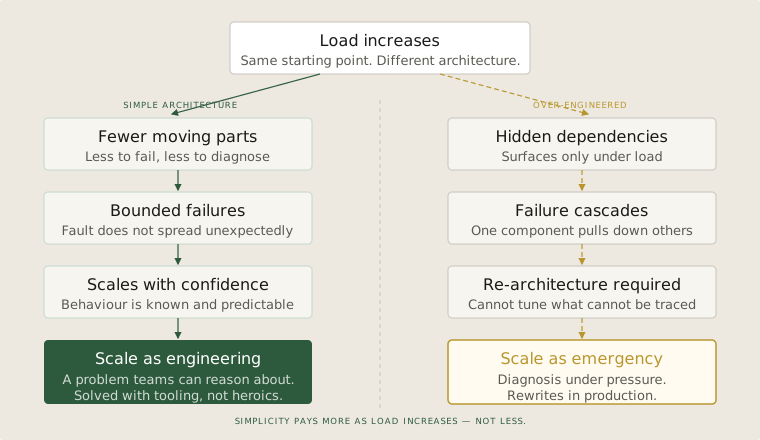
Simple architecture has fewer moving parts. When something breaks — and things always break — the failure is contained, visible, and fixable. The team does not need a specialist to diagnose what went wrong. They can read the system's behaviour and respond without escalating to the one person who remembers how it was built.
Simple also means that onboarding a new engineer does not require a two-week archaeology project. The design should be explainable in thirty minutes. If it is not, that is a signal worth paying attention to.
Why scale rewards simplicity
Here is something counterintuitive: the more load you put on a system, the more aggressively simplicity pays off. At small scale, complexity is annoying. At enterprise scale, it is dangerous.
When you scale a system, you scale everything — including its failure modes. If your architecture has ten integration points, a spike in traffic means ten places where things can degrade. If it has three, you have three. The arithmetic is unforgiving.
The organisations that handle scale well are the ones that removed things before they needed to scale, not after. They chose boring, well-understood technology over clever new tools. They resisted the urge to add a new layer every time a new problem appeared.
The conversation that matters most
In most architectural reviews, the question on the table is: does this design solve the problem? The question that rarely gets asked is: what does this design make harder?
Every architectural choice creates obligations. More services means more observability infrastructure. More integrations means more failure scenarios to plan for. More environments means more deployment pipeline complexity. Good architecture is not just about what you build — it is about what you are committing to maintain, at 2am, under pressure, for the next five years.
That conversation is harder. It requires the people in the room to be honest about operational burden, not just technical capability. But it is the conversation that prevents the expensive re-architectures that organisations face when systems built for agility become anchors.
The question worth asking
Architecture is not a deliverable. It is a set of decisions made over time, under uncertainty, by people who are trying to balance competing pressures. The architects who hold simplicity longest are not the ones who designed the most sophisticated systems. They are the ones who kept asking: do we really need this?
Simplicity is not a compromise. It is a discipline. And it is the one quality that tends to matter most when the system has to perform under conditions that nobody predicted.
The conversation to have
- Audit your architecture for things that exist because of a past decision nobody revisited — not because they are still needed.
- When reviewing a new design, ask what it makes harder, not just what it solves.
- Choose boring, well-understood technology for load-bearing parts of your system. Save clever for the edges.