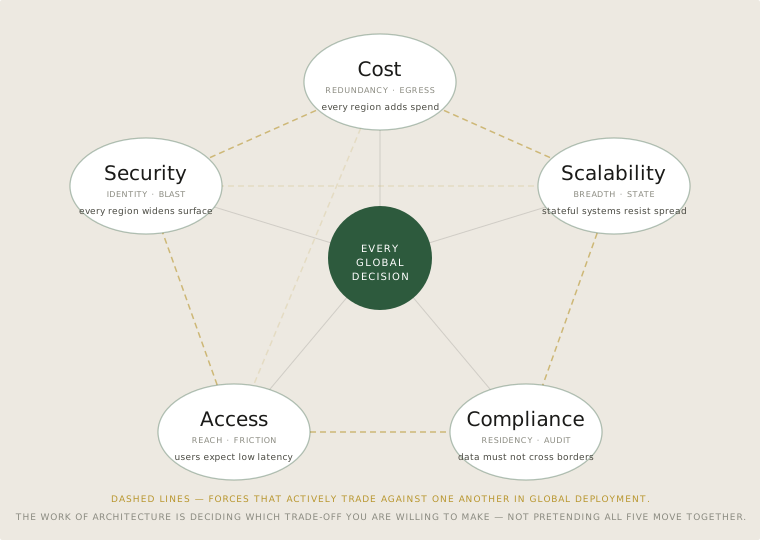
There is a slide that appears in almost every global programme. It lists five goals — usually some version of cost-efficient, secure, accessible, scalable, and compliant — with a confident tick mark beside each. The slide is not wrong. It is just describing a destination, not the terrain. Because the truth that takes years to learn, and minutes to forget, is that these five rarely move in the same direction. Improve one and you almost always spend something from another. The work of architecture is not achieving all five. It is deciding, deliberately and in the open, which one you are willing to pay for the others.
Inside a single data centre, in a single country, the tensions are mild enough to ignore. You can have low latency and tight control and a simple compliance story all at once, because everything sits behind one perimeter under one jurisdiction. Global deployment removes that luxury. Suddenly your users are eight time zones from your data, your data is subject to three regulators who disagree, your attack surface has multiplied by the number of regions you opened, and the bill arrives in currencies you did not budget for. The five forces were always in tension. Going global is simply what makes the tension impossible to avoid.
Let me take each force honestly, and then show why the same five behave completely differently depending on whether you are running a bank, an aerospace platform, a shipping line, or an oil and gas operation.
Cost is never just infrastructure
The cost most teams model is the easy one: compute, storage, network, licences, multiplied across regions. That number is real, but it is the smallest part of the story. The expensive cost of going global is the cost of redundancy you cannot avoid. Every region you stand up for resilience or data residency is a region you now patch, monitor, secure, audit, and staff. A second region does not cost twice as much; it costs more than twice, because you have also bought the coordination problem between them.
Then there is the cost of egress — the quiet tax on moving data between regions and out to users — which has ended more multi-region designs than any architectural flaw. And the cost of latency mitigation: the caches, the edge nodes, the replicas you add purely so a user in Singapore does not wait on a database in Frankfurt. None of these appear on the original slide. All of them are the consequence of choosing accessibility and scalability over a simpler, cheaper, single-region life.
Security and accessibility are opposite ends of the same dial
This is the tension people understand least until it bites them. Accessibility — letting the right people reach the system easily, from anywhere, with minimal friction — and security — keeping the wrong people out, containing blast radius, proving who did what — are not separate goals you can independently maximise. They are two ends of one dial. Every step toward frictionless global access is, by definition, a step that someone in security has to compensate for elsewhere.
Open the system to users in forty countries and you have opened it to attackers in forty countries. Add single sign-on so access is seamless and you have created a single point whose compromise is catastrophic. Push services to the edge for speed and you have pushed your perimeter outward to places you control less well. None of this means accessibility is wrong. It means accessibility is never free, and the price is paid in security architecture — identity as the real control plane, zero-trust assumptions, segmentation that limits how far a breach can travel. The organisations that go global well are the ones that decided early that identity, not the network perimeter, was the boundary that mattered. The ones that struggle are the ones still trying to draw a wall around something that now spans the planet.
Every step toward frictionless global access is a step that someone in security has to compensate for elsewhere. The dial does not have a setting where both ends win.
Scalability is the force that hides its own cost
Scalability is the most seductive of the five, because in the demo it only ever looks like upside. More users, more regions, more load — and the architecture absorbs it. What the demo never shows is that scale is bought with complexity, and complexity is paid for in every other force at once. A system designed to scale horizontally across regions is a system with more moving parts to secure, more surfaces to keep compliant, more replication to fund, and more failure modes to reason about at three in the morning.
The deeper trap is scaling the wrong thing. It is a common pattern: enormous effort spent making a stateless front end scale to millions while the real constraint — a shared database, a licensing model, a regulator who limits where records may live — sat untouched and eventually decided the ceiling anyway. Scalability is not a property you bolt on. It is a property you design for by removing the things that cannot scale, which usually means making hard, early decisions about state, about data gravity, and about which parts of the system are allowed to be global and which must stay local.
Compliance is the only force that can override the rest
The first four forces trade against each other. Compliance is different, because compliance can simply remove options from the table. A regulator who says certain data may not leave a country is not expressing a preference to be balanced against cost and latency — they are deleting the architecture you would otherwise have chosen. This is why mature global teams treat compliance not as a final checklist but as a constraint they design within from the first diagram.
Data residency reshapes where your regions go. Sovereignty requirements reshape who may operate them. Audit and retention obligations reshape how you store and for how long. Sector-specific rules — and they are always specific — reshape what "secure enough" even means. The expensive mistake is to design the elegant, cost-optimal, globally fluid system first and discover compliance second. By then the constraint is not a parameter you tune; it is a wall you have already run into, and the redesign costs a programme.
The same five forces, four different industries
Here is the part that experience teaches and frameworks rarely capture: these five forces do not have a universal ranking. The right balance is decided by the industry you are deploying into, because each one punishes a different failure most severely.
Banking and financial services
In banking, compliance and security sit at the top, and they are close to non-negotiable. Data residency rules, financial regulators in every jurisdiction, and the simple fact that the product is trust mean that an accessibility win is never worth a compliance loss. Scalability matters enormously — payment volumes are brutal and spiky — but it is pursued within a cage that compliance and security build first. The characteristic banking architecture is therefore regional by design, identity-led, heavily audited, and willing to spend on redundancy and control that a less regulated business would consider extravagant. Cost is real but it is rarely the deciding vote. The deciding vote is: can we prove, to a regulator, that this was safe and where it was supposed to be.
Aerospace and defence
Aerospace shifts the centre of gravity again. Here security and sovereignty dominate so heavily that they reshape everything beneath them. Systems may be required to run in specific countries, operated by specific cleared personnel, isolated from the public internet entirely. Accessibility in the consumer sense barely applies; the goal is controlled access for a small, verified population, not frictionless reach for the world. Scalability is often bounded and predictable rather than explosive. And cost, while it matters, bends to assurance — the cost of a security or integrity failure is measured in lives and national consequence, not lost revenue. The architecture that results is the near-opposite of a consumer platform: deliberately constrained, deeply segmented, optimised for verifiability over convenience.
Shipping and logistics
Shipping inverts several of the assumptions. The defining force here is accessibility under hostile conditions — a vessel mid-ocean, a port with intermittent connectivity, a partner network spanning dozens of countries and legal systems. The architecture must tolerate disconnection and reconcile later, which makes edge capability and eventual consistency first-class concerns rather than edge cases. Scalability is about breadth — many sites, many partners, many data formats — more than raw transaction volume. Compliance is real but fragmented across maritime, customs, and trade regimes rather than concentrated in one fierce regulator. And cost discipline is sharper than in banking or aerospace, because margins are thinner and the operational environment is unforgiving. The winning design is resilient, distributed, and tolerant of the messy reality that you do not always have a clean connection home.
Oil, gas, and heavy industry
In energy and heavy industry, the dominant tension is between a global corporate layer and deeply remote, often harsh, operational sites — rigs, refineries, pipelines, plants. Accessibility means reaching equipment and telemetry in places with marginal connectivity and real physical risk. Security carries an operational-technology dimension that most sectors never face: a breach is not only a data problem, it can be a safety and environmental one. Scalability is about ingesting enormous volumes of sensor and operational data reliably. Compliance spans environmental, safety, and increasingly sovereignty regimes. And cost is scrutinised hard, but availability often outranks it — unplanned downtime at an operational site can dwarf any infrastructure saving. The architecture splits naturally into a global analytical plane and a hardened, autonomous local plane that must keep running even when the link to headquarters does not.
What this means in practice
The lesson underneath all four is the same. There is no global architecture that is simultaneously cheapest, most open, most secure, most scalable, and most compliant — and anyone who shows you one has quietly hidden the trade-off rather than solved it. The useful move is to name the tension out loud, decide which force your industry punishes most severely, and let that decision cascade honestly through the design.
Practically, that means a few disciplines worth holding to. Decide your compliance and residency constraints before you draw regions, not after, because they delete options rather than tune them. Treat identity as the real boundary once the network perimeter has dissolved across geographies. Model the costs that hide — egress, redundancy, latency mitigation, the coordination tax of every additional region — not just the line items in the cloud calculator. Scale by removing what cannot scale before celebrating what can. And accept that accessibility and security share one dial, so that every convenience you grant is a control you must add somewhere else.
The five forces never stop pulling against each other. Going global does not resolve the tension; it raises the stakes of how you balance it. The architectures that hold up are not the ones that pretended the tension away. They are the ones where someone sat in a room, said plainly which force had to win and which would have to give, and wrote it down before the first region went live.