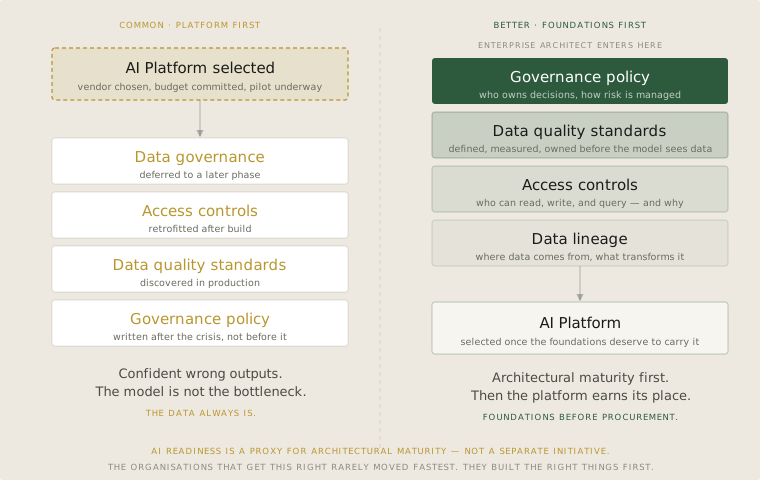
When an organisation announces it is becoming AI-ready, the first thing that usually happens is a procurement conversation. Which platform. Which vendor. Which use case gets the pilot budget. The architecture conversation — if it happens at all — comes third or fourth.
This is the wrong order. And it is the reason so many AI initiatives stall six months after launch, not because the technology failed, but because the foundations were never there to support it.
Enterprise architects are supposed to catch this. The ones who do it well are not the people who know the most about AI. They are the people who understand what needs to be true before AI can be useful — and who are willing to say so before the budget is committed.
The job that is hard to explain
Enterprise architecture is one of the most misunderstood disciplines in technology. Ask ten people what an enterprise architect does and you will get ten different answers. Some will say strategy. Some will say governance. Some will say they are the people who draw diagrams that nobody reads.
The honest answer is simpler. Enterprise architects make decisions that are expensive to reverse — and they try to make those decisions at the right time, with the right people, before the organisation has already committed to something it cannot easily undo.
That is not glamorous work. It does not show up in product launches or quarterly metrics. But it is the work that determines whether a technology investment compounds over time or becomes a liability.
What AI readiness actually requires
Most organisations approaching AI have a data problem they have not fully acknowledged. Data that exists in silos. Data quality that has never been formally measured. Governance policies that were written for a different era and have not been revisited since cloud adoption changed everything.
AI does not fix poor data foundations. It amplifies them. A model trained on inconsistent, ungovernend data does not produce cautious outputs — it produces confident wrong ones. And in an enterprise context, confident wrong outputs at scale are significantly worse than no outputs at all.
The architectural work that enables AI is therefore not about model selection or infrastructure sizing. It is about data lineage, access controls, quality standards, and governance frameworks that were probably overdue before AI entered the conversation.
AI readiness is a proxy for architectural maturity. The organisations that adopt it well are rarely the ones that moved fastest. They are the ones that already had their house in order.
The decisions that matter most
Enterprise architects working on AI programmes spend most of their time on questions that rarely appear in vendor presentations. Where does the data live, and who owns it? What happens when a model produces an output that affects a regulated decision? How do you audit a system whose reasoning is not fully transparent?
These are governance questions, not engineering questions. But they have to be answered before the engineering starts — because retrofitting governance into an AI system that is already in production is substantially harder than designing for it from the beginning.
The same principle applies to integration. AI components do not exist in isolation. They sit inside larger systems — feeding from upstream data pipelines, producing outputs that downstream processes depend on. The architectural question is not whether the model works in the demo. It is whether the system around the model is robust enough to carry it into production safely.
Why the role gets miscast
Enterprise architects are sometimes positioned as gatekeepers — the people you need approval from before you can do anything interesting. This is a failure of how the role has been used, not a reflection of what it should be.
The architects who add the most value in AI programmes are the ones embedded early, asking uncomfortable questions when they are still cheap to answer. Not the ones reviewing designs after the build has started, raising concerns that everyone already knows cannot be addressed without significant rework.
Timing is most of the job. An architectural decision made at the right moment costs very little. The same decision made six months later, after commitments have been made and teams have built on top of an unstable foundation, can cost significantly more — in time, money, and organisational trust.
What the role protects
Enterprise architects are not there only to make technology work today. Their harder job is to make sure the investment still makes sense years later. That distinction matters more in an AI context than almost anywhere else — because the gap between a successful pilot and a system that stays useful in production is almost always an architectural problem.
The organisations that get AI right will not be the ones that moved fastest or spent the most. They will be the ones that asked the harder questions early and built the right foundations before the pressure arrived. The architect's job, at those moments, is sometimes to slow things down. That is less comfortable than it sounds when the room wants to move.
Questions worth asking
- Assess your data governance and quality standards before committing to an AI platform — the model is rarely the bottleneck; the data almost always is.
- Bring architecture into AI programmes at the start, not the review stage. The expensive decisions are the ones made before the architect enters the room.
- Treat AI readiness as a measure of existing architectural maturity, not a separate initiative to run in parallel with everything else.