Most organisations have encountered the problem without naming it. A solution gets designed and delivered. It works. The team is pleased. Six months later, it does not integrate cleanly with the next initiative. A year after that, it is creating friction for a programme nobody anticipated when the original decision was made.
Nobody made a bad decision. The solution architect solved the right problem, well. The enterprise architect was thinking about the long-term landscape but was not close enough to the delivery to catch the mismatch in time. The gap between them — that is where the cost accumulates.
The Enterprise Solution Architect exists to close that gap.
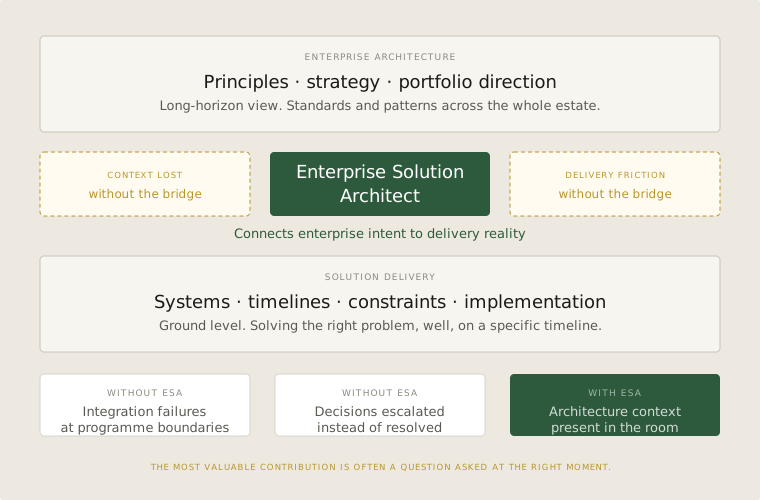
The difference is not just a title
Enterprise Architects operate at altitude. Their work is about patterns, principles, standards, and the long-horizon view of how technology should evolve to support business strategy. They are essential. But they are often one or two steps removed from the immediate decisions being made inside delivery programmes.
Solution Architects operate at ground level. Their work is about designing a specific system to solve a specific problem, on a specific timeline, with specific constraints. They are equally essential. But without broader context, even well-designed solutions can create problems downstream that were entirely avoidable.
An Enterprise Solution Architect moves between both levels with fluency. They bring the enterprise perspective into solution design — and they bring the pragmatism of delivery into enterprise thinking. That translation is the work. And it is harder than it sounds.
What this looks like in practice
In a delivery programme, an Enterprise Solution Architect is the person asking questions that the project team may not have thought to ask yet. Does this integration pattern align with the direction the platform is heading? Are we introducing a dependency here that will constrain a decision we need to make in eighteen months? Is the data model we are designing consistent with what the enterprise data strategy requires?
These questions are not obstructions. They are the conversations that prevent expensive surprises. Raised early, they cost an afternoon. Raised after go-live, they can cost a programme.
At the same time, an Enterprise Solution Architect is grounded enough in delivery reality to know which standards are worth holding firm on and which require pragmatic adaptation. Governance applied without judgment is bureaucracy. The skill is in knowing the difference.
The most valuable architectural contribution is often not a diagram or a document. It is a question asked at the right moment, before a decision becomes difficult to reverse.
How this benefits the business
The case for this role is not abstract. It shows up in outcomes that are mostly invisible when things go well — and very visible when they do not.
Fewer integration failures at programme boundaries. Solutions that were designed with the enterprise landscape in mind do not require significant rework when they need to connect to other systems. The cost of that rework — in time, budget, and team morale — is one of the most consistent sources of waste in large technology portfolios.
Faster decision-making at the programme level. When a delivery team has access to someone who understands both the enterprise context and the solution constraints, decisions that would otherwise require escalation to separate architecture forums can be made at the right level, at the right time. Programmes move faster when the architectural context is present in the room, not waiting in a review queue.
Better investment decisions at the portfolio level. When solutions are designed consistently — using shared platforms, aligned data models, and common integration patterns — the organisation builds leverage rather than complexity. Each new initiative builds on what already exists rather than adding to the maintenance burden.
The skill set that makes it work
What makes an Enterprise Solution Architect effective is not technical breadth alone, though that matters. It is the ability to hold two conversations at once — one with the business stakeholder who needs to understand why a decision matters, and one with the engineering team who needs to understand how to implement it.
It also requires a particular kind of patience. The rhythm of a delivery programme is different from the rhythm of strategy work — decisions get made faster, with less information, under more pressure. The discipline is in knowing which of those decisions deserve to slow down.
And it requires credibility in both directions. The enterprise architecture community needs to trust that the solution work is being done in alignment with their principles. The delivery team needs to trust that the architectural input is practical, not theoretical. That dual credibility takes time to build and is easy to lose.
What the gap actually costs
Organisations that separate enterprise architecture from solution delivery entirely pay for it in integration costs, rework, and the quiet accumulation of technical debt that nobody budgeted for. Organisations that blur the boundary completely lose the strategic perspective that keeps the long-term landscape coherent.
The Enterprise Solution Architect holds the boundary deliberately — moving across it as the situation demands, bringing clarity in both directions. It is not the most visible role in a technology organisation. But it is frequently the one that determines whether the portfolio compounds in value or compounds in complexity.
The title may vary. The need does not.
What to watch for
- If your enterprise architects are not present in delivery programmes until the review stage, you are solving the wrong problem at the wrong time — move them upstream.
- The value of architectural consistency compounds. Solutions designed in alignment with the enterprise landscape cost less to integrate, less to maintain, and less to evolve.
- Dual credibility — trusted by both the strategy community and the delivery team — is what makes this role work. It cannot be assumed; it has to be earned through consistent, practical contribution on both sides.