When infrastructure works, nobody talks about it. Applications deploy. Data moves. Users connect. The business runs. The infrastructure architect who designed all of that receives no particular credit — because the measure of good infrastructure is invisibility.
When infrastructure fails, everyone notices immediately. And the first question asked is always the same: why was this not designed better from the start?
That gap — between silent success and sudden crisis — is where infrastructure architects spend most of their professional lives.
More than servers and cables
The common perception of infrastructure architecture is that it is operational work dressed up with a fancier title. Servers, storage, networking, backups. Important, certainly — but not strategic. That perception is wrong, and it costs organisations significantly when they act on it.
Infrastructure architecture is design work. It is the discipline of making decisions about how compute, network, storage, and platform components should be arranged, connected, and governed — so that the systems built on top of them can perform reliably, scale predictably, and recover from failure without catastrophe.
Those decisions have long lead times and long consequences. A networking topology chosen today will constrain or enable security posture, cloud connectivity, and application performance for years. A storage architecture that optimises for cost over resilience will be forgotten until the moment it matters most. Infrastructure architects are paid to think far enough ahead that the organisation does not have to learn these lessons the hard way.
The decisions that define everything downstream
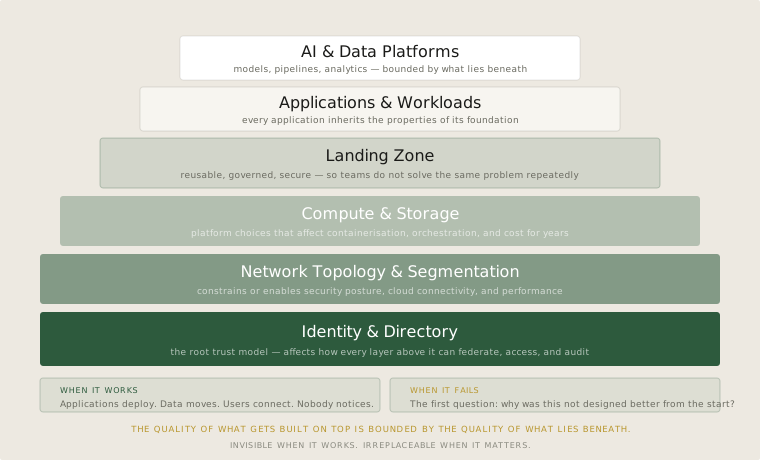
Every application, every platform, every cloud workload sits on top of infrastructure. The design choices made at that foundation layer either create options or eliminate them — often before the teams building on top are even aware a choice was made.
Network segmentation decisions affect what zero-trust security controls are possible. Identity and directory architecture affects how cleanly cloud and on-premises systems can federate. Compute platform choices affect how workloads can be containerised and orchestrated. Data centre topology affects recovery time objectives when things go wrong.
None of these are purely technical concerns. Each one has direct business implications — for regulatory compliance, for operational cost, for the pace at which the organisation can adopt new capabilities. Infrastructure architects who understand this translate those implications clearly. The ones who do not leave the business making expensive decisions without realising they were architectural decisions at all.
Good infrastructure architecture does not announce itself. It simply makes everything that runs on top of it work better than it would have otherwise.
The shift that changed the role
Cloud has fundamentally changed what infrastructure architecture means in practice — and not entirely in the ways people expected.
The physical work of specifying and procuring hardware has largely moved to providers. But the design work has not gone away. It has shifted. Infrastructure architects now spend less time on capacity planning for data centres and more time on landing zone design, hybrid connectivity patterns, identity federation, platform governance, and the infrastructure-as-code practices that make environments reproducible and auditable.
In some organisations, this shift has been misread as a signal that infrastructure architecture matters less. The opposite is true. The decisions are now more consequential, not less — because they are harder to reverse. Committing to a cloud networking topology, a security baseline, or a platform architecture is not like ordering a different server. These are decisions that the organisation will live with for years, and that every team building in the cloud will either benefit from or be constrained by.
Where infrastructure architects add the most value
The highest-value contribution an infrastructure architect makes is not in execution. It is in the definition of standards and patterns that mean individual delivery teams do not have to solve the same foundational problems repeatedly — and do not make inconsistent choices that create integration and security problems at the portfolio level.
A well-designed landing zone means a new cloud workload can be provisioned in a secure, compliant, well-networked environment without requiring a specialist to configure it from scratch. A well-documented reference architecture for hybrid connectivity means each new site or workload does not reinvent the same design. A solid identity platform means application teams can integrate authentication without building security controls they are not qualified to build well.
This is leverage. The infrastructure architect who invests in reusable, well-governed patterns multiplies the effectiveness of every team that builds on them. It is not visible in any single project. It compounds quietly across the portfolio.
What the foundation actually decides
The quality of what gets built on top of an infrastructure foundation is bounded by the quality of what lies beneath. That is not a metaphor; it is how the failures eventually arrive. Organisations that treat infrastructure as a commodity function — something to be minimised, outsourced, or left to operations to figure out — discover this boundary at the worst possible moments.
The infrastructure architects doing this work well are not the ones who can configure the most platforms. They are the ones who understand what the business needs from its technology foundation over the next five years — and who make decisions today that keep those options open rather than closing them prematurely.
Invisible when it works. Costly when it does not.
What to carry forward
- Infrastructure decisions have long consequences — treat landing zone design, network topology, and identity architecture as strategic choices, not operational ones.
- Cloud shifts the work, it does not reduce it. The infrastructure architect role is more consequential in a hybrid or cloud-first environment, not less.
- Reusable patterns and reference architectures are where infrastructure architects create the most leverage. Investment in shared foundations compounds across every team that builds on them.