When I speak to small business owners about technology, the first thing they usually describe is a tool — the software they use for accounts, the system they use for bookings, the platform where their files live. They frame everything through tools. What they are actually describing, if you listen carefully, is a set of frustrations: things that do not work when they need to, data they cannot find, processes that depend on one person who happens to know how everything fits together.
The tools are not the problem. The absence of foundations is.
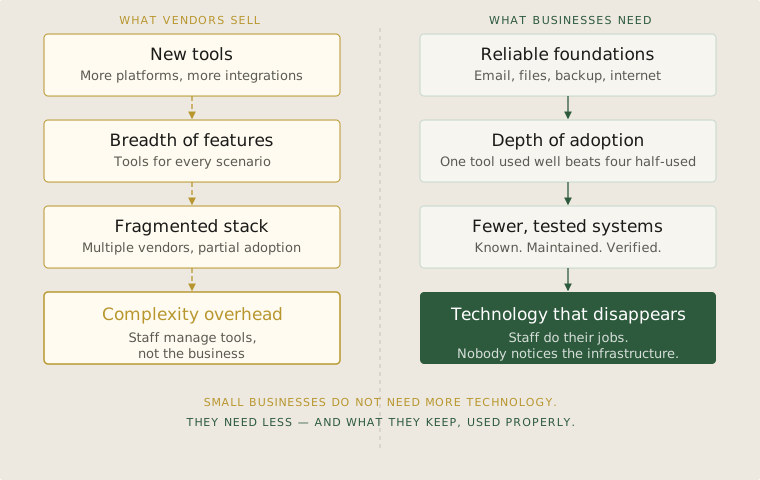
What foundations actually means for a small business
In enterprise environments, we talk about foundations in formal terms — infrastructure, platforms, governance. For a small business with ten or fifteen people, the same concepts apply, just at a different scale. The questions are the same. Where does the data live, and can you get to it if your main computer fails? When someone leaves, can you still access the accounts they managed? If your internet goes down this afternoon, can your team continue working?
These are not technology questions. They are business continuity questions. But the answers are almost entirely determined by technology decisions — most of which get made accidentally, by default, or by whoever set the system up three years ago and has since moved on.
The businesses that recover quickly from technology failures — a ransomware attack, a hardware failure, a key person leaving suddenly — are the ones that had thought about these questions before the event occurred. Not with sophisticated planning. With basic hygiene: accounts they controlled, backups they had tested, documentation someone other than the IT person could read.
The gap the market creates
The technology market does not serve small businesses particularly well, and it is worth being honest about why. Vendors sell products. Products need problems to solve. So the conversation is always framed around capability — what the new tool can do, what features it has, what the upgrade unlocks. The conversation that rarely happens is: before you add this, is what you have already working reliably?
A common pattern: five different cloud subscriptions, none of them fully adopted, all billing monthly, with data scattered across all five because nobody decided which one was primary. The business owner thinks they have a modern setup. What they have is expensive fragmentation.
Adding tools to an unreliable foundation does not improve reliability. It increases the surface area for things to go wrong.
What reliability actually requires
For most small businesses, reliable technology is achievable with a very small set of things done consistently well. Email that works and is properly backed up. File storage that is accessible from anywhere and does not depend on a single machine. A backup that is tested, not just configured. Internet connectivity with some form of redundancy for the days when the primary connection fails. Devices that are maintained — updated, not running on outdated software that has not received security patches in eighteen months.
None of this requires enterprise-grade architecture. It requires decisions that have been made deliberately, by someone who thought about what happens when each of these things fails. The cost of doing this properly is not high. A few hours of thinking, a few hundred rupees a month in the right places, and a document that lists what you have, who controls it, and what to do if the person managing it becomes unavailable.
The conversation worth having
If you run a small business, the most useful technology conversation you can have is not with a vendor. It is with yourself, or with someone who will ask you honest questions without trying to sell you anything. What would you lose if your primary device failed tonight? How long would it take to be fully operational again? Is there any part of your business that only one person knows how to operate?
Technology should make a business more resilient. When it makes a business more dependent — on a single tool, a single person, a single vendor — something has gone wrong in the decisions that led there.
What reliable technology actually takes
Small businesses do not need more technology. Most of them need less — and what they keep, they need to use properly. Reliability comes from depth of adoption, not breadth of tools. One file storage system used well is worth more than four used partially. One backup process tested monthly is worth more than three configured and forgotten.
The businesses that have their technology working for them, rather than against them, are not the ones that spent the most. They are the ones that made a few decisions deliberately and then held to them.
Before the next decision
- Before adding any new tool, ask whether what you have is working reliably. Fragmentation across half-used systems is not a modern setup — it is expensive confusion.
- Answer three questions honestly: What would you lose if your primary device failed tonight? Can you access your accounts without the person who set them up? Have you tested your backup in the last three months?
- Reliability comes from depth, not breadth. One system used well consistently outperforms four systems used occasionally. Make fewer decisions and honour them.