I have walked into infrastructure environments where the monitoring dashboard looked like a flight cockpit — hundreds of alerts, dozens of blinking indicators, a constant background noise of warnings that nobody was acting on. When I asked the team how they knew what was actually critical, the answer was usually some version of: "You just learn which ones to ignore."
That is not operational knowledge. That is accumulated tolerance for dysfunction. And the organisations that run this way do not scale — they survive, until one day the thing they were ignoring turns out to matter.
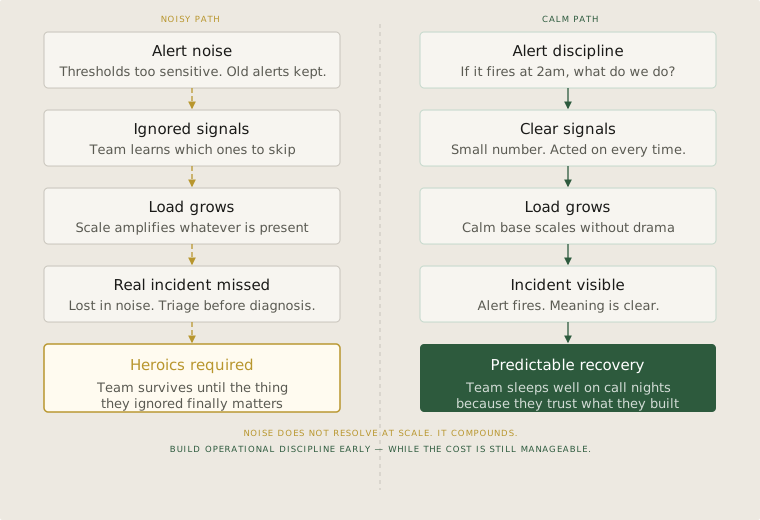
What calm actually looks like
Calm infrastructure is not quiet because nothing is happening. It is quiet because the signals it produces are meaningful. An alert fires, and the person who receives it knows exactly what it means, what triggered it, and what to do. There is no triage phase where the team first has to determine whether this alert is real or routine. That determination was made when the alert was configured — not at 11pm when something starts degrading.
I have seen this done well in organisations that were not large, not well-funded, and not particularly sophisticated technically. What they had was discipline. Someone had sat down and decided: we will only alert on things we intend to act on. Everything else goes to a log. The result was a small number of alerts that the team took seriously, every time.
That sounds obvious. It is remarkably rare.
Why noise accumulates
Infrastructure noise does not arrive all at once. It builds the same way complexity does — one reasonable decision at a time. A threshold gets set slightly too sensitive because someone was worried. A new monitoring tool gets added without retiring the old one. An alert gets created for an edge case that happened once, three years ago, and has never fired since — but nobody removed it because nobody wanted to be the person who turned off an alert that then immediately mattered.
Each of these decisions made sense in isolation. Together they create an environment where the infrastructure is constantly speaking and nobody is fully listening. When a real problem occurs, it has to compete for attention with everything else. The cost of that noise is not just operational stress. It is the gradual erosion of the team's trust in their own systems.
Scale makes it worse, not better
There is a belief in some organisations that operational maturity will come with scale — that as the infrastructure grows, the processes around it will naturally improve. This is backwards. Scale amplifies whatever is already present. Calm infrastructure at small scale becomes calm infrastructure handled efficiently at large scale. Noisy infrastructure at small scale becomes an operational emergency at large scale.
The right time to build for calm is before you need it. Not when the growth has arrived and the team is already stretched. By that point, the cost of the cleanup competes with the cost of the growth itself — and the cleanup usually loses.
The practical starting point
The organisations I have seen improve this most effectively did not start with a tool. They started with a conversation: if this alert fires at 2am, what do we expect the person on call to do? If the answer is "check whether it's real," the alert is not ready. If the answer is "escalate to someone who knows this area," the ownership is not clear. If the answer is "nothing, this one is informational," the alert should not exist.
That conversation, applied systematically to every alert and every monitoring threshold, does more for operational calm than any platform upgrade.
The simple truth
Infrastructure that is calm to operate was designed to be calm. It requires someone to make the unglamorous decisions about alert thresholds, runbook clarity, and monitoring discipline — decisions that produce no visible output until something goes wrong and nothing is on fire.
The measure is not the sophistication of the platform. Whether the team sleeps well on nights when they are on call — because they built something they trust.
Three things to take away
- If your team has learned which alerts to ignore, you do not have a monitoring system. You have noise with a dashboard. Fix the alerts before you add more infrastructure.
- Noise does not resolve at scale — it compounds. Build operational discipline at small scale, while the cost of doing so is still manageable.
- Ask one question about every alert: what do we expect someone to do when this fires? If the answer is unclear, the alert is not ready to exist in production.