I have sat in hundreds of architecture reviews. The ones that led to good outcomes had one thing in common: someone in the room was willing to ask an uncomfortable question at the moment when it was still cheap to answer. The ones that led to poor outcomes had a different pattern: the meeting moved quickly toward consensus, uncomfortable questions were noted for later, and "later" never arrived before the budget was committed.
Architecture fails in meetings because meetings are socially oriented toward agreement, and architecture requires the discipline to hold disagreement open long enough to resolve it honestly.
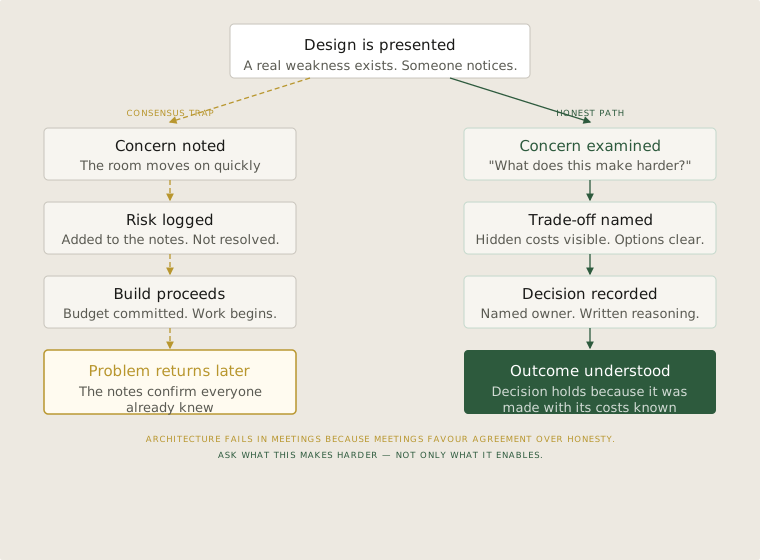
The consensus trap
Large organisations reward people who move things forward. Architects who ask difficult questions, slow meetings down, or surface uncomfortable trade-offs are often perceived as obstacles rather than contributors. This creates a gradual pressure toward architecture that is agreeable rather than architecture that is sound.
The consensus trap looks like this: a design is presented that has real weaknesses. Someone notices. They raise it briefly. The room absorbs it and moves on. The issue is logged in the meeting notes under "risks to be mitigated." The design proceeds. Six months later, the risk materialises and becomes a crisis — and the meeting notes confirm that everyone knew about it in advance.
This is not a failure of knowledge. It is a failure of process. Good architectural decisions require creating conditions where the difficult question can actually be heard, not just noted.
What architects get wrong about influence
Many enterprise architects believe their job is to provide the right answer. It is not. Their job is to create the conditions in which the right decision can be made — which means understanding who is in the room, what they are optimising for, and what kind of question will actually land with the people who have decision authority.
An architect who presents a technically correct recommendation in a way that the business stakeholder cannot engage with has not done their job. The recommendation has failed regardless of its technical merit. Good architecture communication is translation work — and the translator bears the responsibility for being understood, not the audience.
The architects who have the most influence in meetings are not the ones with the deepest technical knowledge. They are the ones who have learned to make the technical consequence of a decision legible to the people who will live with it.
The question that changes the room
There is one question that tends to shift the dynamic in architectural decision-making more than any other: "What does this decision make harder?" Not what does it enable — everyone has already covered that. But what does it close off? What will cost more in eighteen months because of this choice? What flexibility are we giving up, and is that trade-off explicit?
This question works because it does not challenge the proposal directly. It asks the room to think forward. It surfaces the hidden cost of the current direction without requiring the architect to play the role of obstruction. And it creates space for the people who already have concerns — but have not felt safe raising them — to contribute.
Most of the real architectural work in a meeting is not presenting. It is listening for the things people are not saying, and finding a way to put them on the table without making anyone feel attacked.
Where decisions actually break down
Enterprise architecture does not fail because engineers make poor technical choices. It fails because the social dynamics of decision-making favour speed over rigour, and consensus over honesty. The uncomfortable questions get logged as risks. Then they materialise.
The architect who understands this — and who learns to create better conditions for a decision, not just a better recommendation — is the one whose work tends to hold.
A practical check
- Architecture fails in meeting rooms, not data centres. The decisions that create technical debt are almost always made in rooms where uncomfortable questions were surfaced and then quietly set aside.
- Ask "what does this make harder?" rather than challenging proposals directly. It surfaces trade-offs without requiring the architect to appear obstructive.
- Influence in architectural decisions comes from translation ability, not technical depth. Being understood by decision-makers is the job — not being technically correct in isolation.